
Why are people going deeper online?
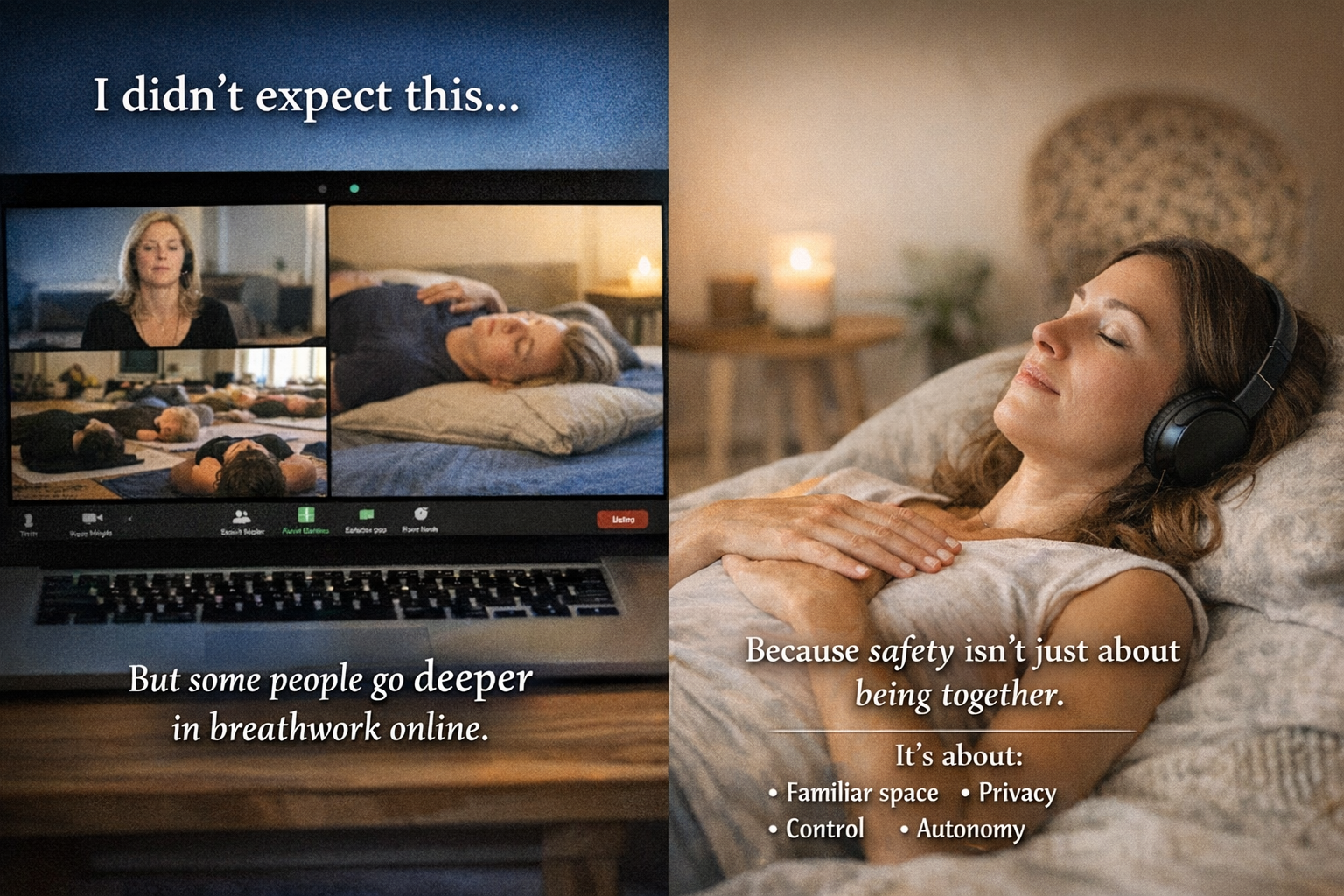
I didn’t expect this.
When I first began offering Conscious Connected Breathwork online, I assumed the depth would be greater in person. Shared space. Co-regulation. Bodies breathing together.
But what I’ve been noticing is something different.
Some people go deeper online.
Not always. Not everyone.
But often enough that it’s made me pause and really consider why.
What I Mean by “Deeper”
I’m not talking about performance.
I’m noticing:
Stronger breath-induced shifts
More spontaneous movement
Fuller emotional arcs
Less holding back
More honest sound
Powerful integration feedback afterwards
There is often a moment online where something softens… and then drops.
And I think safety is the key.
Home Is a Nervous System Variable
When someone is breathing in their own bedroom or living room, their nervous system already knows the environment.
The exits are known.
The sounds are familiar.
The body isn’t scanning an unfamiliar room.
That baseline reduction in vigilance may allow something to unfold more quickly.
In person, even in warm, beautiful spaces, there is still subtle social tracking:
How do I look?
Am I too much?
Is this okay?
Online, with the option to turn the camera off, people sometimes allow themselves to disappear into the process.
And that can create depth.
Autonomy Changes Everything
Online participants can:
Turn the camera off (though for me it’s key to be able to see them to establish safety)
Adjust volume
Lie exactly how they want
Leave briefly
Regulate in their own way
That sense of agency is not small in trauma physiology.
Autonomy often equals safety.
And safety allows surrender.
But What About the Research?
The evidence we have on structured breathing (Balban et al., 2023) shows improvements in mood, anxiety and positive affect.
What it does not show:
That intensity is required
That catharsis predicts outcome
That deeper always equals better
The research supports regulation.
It supports autonomic modulation.
It supports mood shifts.
But it doesn’t measure “how far someone goes.”
And perhaps that’s wise.
The Physiology Beneath It
We know from heart rate variability (HRV) research that slow, rhythmic breathing increases parasympathetic flexibility (Bernardi et al., 2001; Lehrer et al., 2003).
We also know breath-based HRV training has been associated with symptom improvements in clinical groups (Zucker et al., 2009).
Breath influences autonomic tone.
Autonomic tone influences emotional regulation.
And regulation is the foundation that makes depth therapeutic rather than overwhelming.
Intensity Is Not the Goal
As someone trained in EMDR and Somatic Experiencing, I’m always watching for this:
Is the nervous system expanding capacity , or just activating?
Because more activation does not equal more healing.
What I look for the next day is:
Steadier mood
Better sleep
More choice
Less fear of internal sensation
More embodied trust
Sometimes that comes after a very deep session.
Sometimes it comes after a quiet one.
My Current Reflection
Online breathwork can allow depth because:
Familiar space + privacy + autonomy = increased safety.
In-person breathwork offers co-regulation and shared humanity, but it may also activate subtle social containment.
Neither is better.
They are simply different nervous system contexts.
And in trauma-informed work, context is everything.
What matters is not how dramatic the session appears.
It’s whether someone leaves with more capacity to live their life.
Intensity is not the goal.
Restoring health is.
References
Balban, M.Y., Neri, E., Kogon, M.M., Perlmutter, R., Lerner, J., et al. (2023) ‘Brief structured respiration practices enhance mood and reduce physiological arousal’, Cell Reports Medicine, 4(1), 100895.
Bernardi, L. et al. (2001) ‘Effect of rosary prayer and yoga mantras on autonomic cardiovascular rhythms: comparative study’, BMJ, 323(7327), pp. 1446–1449.
Lehrer, P.M., Vaschillo, E. and Vaschillo, B. (2003) ‘Resonant frequency biofeedback training to increase cardiac variability’, Applied Psychophysiology and Biofeedback, 28(2), pp. 121–143.
Zucker, T.L. et al. (2009) ‘The effects of respiratory sinus arrhythmia biofeedback on heart rate variability and posttraumatic stress disorder symptoms: a pilot study’, Applied Psychophysiology and Biofeedback, 34(2), pp. 135–143.